How to recognize genuine hula practices and choose meaningful cultural experiences
Almost everyone who books hula asks for the same thing: something authentic. A parent planning a birthday wants guests to see the real thing. A principal planning an assembly needs a program that teaches accurately. A corporate planner wants an experience that respects the culture it presents. The goal is shared.
What is rarely shared is a clear sense of what authentic actually means.
This guide is for both kinds of buyers: those planning an event and those planning an education program. It covers what authenticity in hula rests on, the red flags worth noticing, how to choose the right format, and why the most trustworthy answer is sometimes a referral.
What People Mean When They Say "Authentic"
When most people picture hula, they picture fast, shaking hips, grass skirts, and coconut tops. That image is real, but it is usually not hula. It is closer to ʻōteʻa, a drum-driven dance from Tahiti with its own history and its own lineage. Hawaiian hula and Tahitian dance share Polynesian roots, yet to anyone who has studied them, they are clearly different traditions.
When a client asks for hula and describes Tahitian dance, Trinity Iwankiw treats it as an opening rather than a problem. She explains the difference between what they asked for and what they pictured, then helps them find either one, or both. Every question like that is a chance to share what makes each Polynesian culture distinct.
That distinction points to the real answer. In Trinity's view, authenticity in hula does not come from a costume or a soundtrack. It comes from lineage: knowledge passed from kumu to kumu, teacher to student, across generations. Without that line of transmission, the traditions, the history, and the foundation of hula are lost, no matter how good the show looks.
Core Elements of Genuine Hula Practice
Genuine hula starts with the story. The chant or song carries the meaning, and the dancer's body gives that meaning form. A performer who knows the words, their layers of meaning, and their history can explain what an audience is seeing. One who only knows the steps cannot.
It continues with training. In hula, lineage is specific and nameable. Kumu hula Vicky Holt Takamine, a longtime Merrie Monarch judge and a 2024 Gish Prize recipient, trained under Maiki Aiu Lake through the rigorous ʻūniki graduation process. Not every authentic performer is a kumu, but every authentic performer can tell you who taught them.
And it rests on understanding. Trinity describes her role this way: a performer is not just a vehicle for the culture but an embodiment of it. That means taking extra time to understand exactly what is being portrayed, and staying aware of the deeper reason behind each choice. Hula has carried Hawaiian knowledge, language, and values through annexation, war, and the rise of tourism. Presenting it well means honoring that weight.
Common Red Flags to Watch For
A few signals suggest an experience is built on appearance rather than practice.
The first is when everything is called hula. Samoan fire knife, Tahitian ʻōteʻa, and Māori poi are each beautiful and each their own, and an honest performer labels them correctly.
The second is when costume does the talking. If the description leads with grass skirts and props instead of stories, songs, and cultural context, the meaning may be missing.
The third is a performer who cannot name their teachers or explain the songs they dance.
The fourth is a performer who says yes to every request, including costumes, characters, or presentations that misrepresent Hawaiian culture. A practitioner who cares about the tradition will tell you, kindly, when something does not fit.
Credentials, Lineage, and Cultural Responsibility
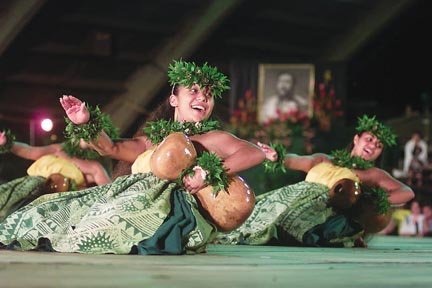
Trinity performing during the 2004 Merrie Monarch Festival.
The lūʻau has played a large role in how the world met hula, and much of it was designed to entertain rather than teach. But the stage itself does not decide what is authentic. Even the Merrie Monarch Festival, the most respected hula event in the world, began as an effort to boost tourism on Hawaiʻi Island before becoming a pillar of cultural preservation. What matters is who leads, and what they carry.
Trinity’s lineage begins in Lahaina, Maui. As a young child, she started training at Kanoʻeau Dance Academy under Kumu Hula Keʻala Kukona, and she went on to compete at the Merrie Monarch Festival with the hālau. That foundation has carried her through more than 30 years of hula.
For nearly twenty of those years, she performed at Old Lahaina Luau, Feast at Lele, and Royal Lahaina Luau. At Old Lahaina Luau, she and her current kumu, Kapono Kamaunu, were both mentored by Charles Kaʻupu, a revered master chanter and kumu hula who served as the lūʻau’s master of ceremonies for 22 years and mentored dancers on Maui, Kauaʻi, in Japan, and on the mainland.
Those stages taught her the lesson she still carries: anyone who presents a culture has to understand what they are portraying, and why. From Kanoʻeau to Merrie Monarch to Lahaina, every teacher in that line expected the same thing. Born in Lahaina and trained in Wailuku, she brings that same responsibility to every event and program in Central Florida.
Choosing the Right Format: Events vs. Education
Event buyers and program buyers want the same integrity for different reasons. If you are planning a celebration, corporate gathering, or milestone, an event performance is designed to create a shared memory with real cultural presence. Most run 30 minutes to an hour and include performance, narration, and audience engagement.
If you need structured cultural learning for students, employees, or community groups, a program is the better fit. Programs are built around age levels, learning goals, and documentation requirements, often with movement, storytelling, and participatory learning across longer or repeated sessions. Schools and organizations can request insurance certificates, background check documentation, and vendor paperwork before scheduling.
When a Referral Is the Right Answer
Some requests call for more than a solo or duo performer can responsibly deliver: a full lūʻau production, a multi-performer show, or a fire knife finale. In those cases, the right answer is not to stretch, and not to send a client to just anyone. Halona Hula works within a close circle of trusted partners, including Uso's Polynesian Entertainment and Netane Polynesian Productions, who carry the same cultural values. Trinity typically still performs in those shows, so the hula portion stays grounded in her lineage.
A referral is not a lost booking. It is a sign that the person you are talking to cares more about getting it right than about saying yes.
How Authentic Hula Creates Meaningful Experiences
When hula is presented with lineage and context, guests do not just watch. Children learn that a hand movement can mean rain, or a mountain, or a name. Students leave knowing that Hawaiʻi and Tahiti are different places with different traditions. Teams share an experience that asks them to listen as well as watch.
If you want to know whether you are talking to the right performer, ask questions that show curiosity about the Pacific: which island traditions they draw from, who taught them, what the songs mean. Underneath every good question is the real one, why should we choose you? A practitioner grounded in lineage will welcome it, because the answer is the whole point.
Frequently Asked Questions
Is Tahitian dance the same as hula? No. Hula comes from Hawaiʻi; ʻōteʻa and other Tahitian dances come from Tahiti. Tahitian ʻōteʻa is faster and drum-driven, with rapid hip movement. Hula is guided by chant or song, and its movements interpret the words. Both are Polynesian, and each has its own lineage and meaning.
How can I tell if a hula performer is authentic? Ask who taught them, and listen for specific names and places. An authentic performer can explain the meaning of the songs they dance, labels other Polynesian dances correctly, and will tell you honestly when a request does not fit the culture.
Can one performer present Tahitian, Samoan, or Māori dance too? Sometimes, and many professional performers are trained across Polynesian styles. What matters is honest labeling. A trustworthy performer will tell your audience which culture each piece comes from instead of presenting everything as hula.
Should I book an event or a program? Choose an event for celebrations, corporate gatherings, and milestones where the goal is a shared cultural experience. Choose a program when you need structured learning with age-appropriate goals, documentation, or multiple sessions, as schools, museums, and workplaces often do.
Conclusion
Authentic hula is not a look. It is a line of knowledge, carried from teacher to student and shared with care. Whether you are planning a celebration or a classroom program, the right choice is a practitioner who can tell you where their hula comes from, what it means, and when something else would serve you better.
That line runs from Hawaiʻi's chanters and kumu, through stages like Lahaina's, to Central Florida today. If you are ready to bring it to your event or program, we would be glad to hear what you are planning.
If you are interested in engaging with hula that is educator-led and culturally grounded, we invite you to continue the conversation.
